
 Menu
 Close
NGBS INSIGHT
Add engineers only when execution is the constraint
Additional engineering capacity creates value when delivery is constrained by available execution—not when the real problem is unclear direction, unresolved decisions or an overloaded operating model.
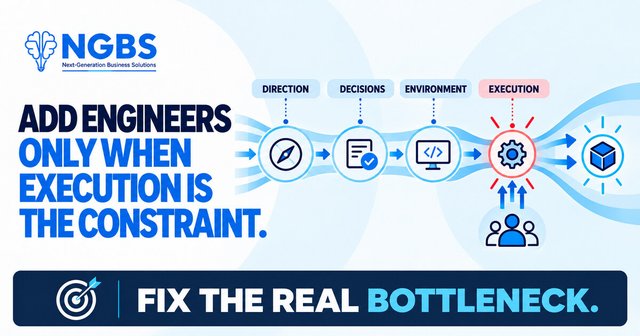
When a roadmap is moving slowly, adding engineers can feel like the most direct response.
Important initiatives wait in the backlog. Customers are asking for improvements, and technical debt competes with new product development. More capacity appears to be the obvious answer.
Sometimes it is.
But engineering output is not determined by headcount alone. A team also depends on clear direction, timely decisions, usable environments and enough leadership attention. If one of those is the real constraint, adding people can increase coordination without increasing delivery.
Before expanding a team, leaders should identify what is preventing the existing system from producing more valuable software. Additional engineers are effective when execution capacity is scarce. They are much less effective when the organisation cannot provide the direction and decisions that execution requires.
Capacity solves a particular kind of problem
An engineering-capacity problem exists when the organisation has credible work ready to be delivered but not enough capable people to execute it at the required pace.
Product priorities are understood. Work can be divided without creating artificial dependencies. Engineers have access to the systems and people they need. The current team is progressing, but valuable work consistently exceeds what it can complete.
In that situation, added capacity can shorten queues, increase ownership and allow important workstreams to move in parallel.
Many delivery problems produce the same symptom: a late roadmap. The cause may be limited execution, unstable priorities, delayed decisions, poor release infrastructure or too much work in progress.
More engineers address only one of those causes directly.
Direction must exist before execution can scale
Engineers can help refine a problem and challenge assumptions, but they cannot replace product ownership.
If priorities change every few days, requirements have no responsible decision-maker or stakeholders disagree about the outcome, additional engineers will wait, interpret or build against assumptions. The organisation may generate more activity while increasing the amount of work that is later revised or abandoned.
Before expanding capacity, leaders should be able to explain which problem matters, what outcome represents progress and who can resolve product trade-offs.
This does not require a perfect specification. Strong engineering teams work effectively with uncertainty. They still need a stable enough direction to investigate the right uncertainty.
Decisions must keep pace with the team
Every additional engineer creates more opportunities for questions and choices.
Which pattern should a new service follow? Can an interface change without supporting the old behaviour? Is a temporary compromise acceptable for the first release? Who can approve a change affecting security or data ownership?
When decision authority is unclear, these questions become queues. Engineers either wait for a senior leader, make inconsistent assumptions or introduce local solutions that later need to be reconciled.
Adding capacity therefore increases the importance of decision paths. Product, architecture, security and operational decisions may have different owners, but the team should know where each belongs.
If the organisation’s technical leaders are already the main bottleneck, adding more people without changing the decision system may increase pressure on exactly the leaders who have the least available time.
The operating environment must absorb new capacity
An engineer cannot contribute effectively without access to the product’s working environment.
That includes repositories, environments, delivery tools, documentation, communication channels and people holding essential context. It also includes a safe route to release and observe work.
When access takes weeks, environments are unreliable or every release depends on one unavailable person, new engineers spend their early time navigating friction rather than increasing delivery.
Some onboarding cost is unavoidable. The question is whether the system can convert it into growing ownership. One or two engineers absorbed thoughtfully may create more value than a larger group introduced before access, standards and support are ready.
Look for evidence that execution is the limiting factor
Leaders do not need a complex capacity model. A practical assessment can begin with five questions.
1. Is valuable work consistently ready?
There should be a credible queue of outcomes, product improvements or engineering work that the organisation has already decided matters. A large backlog alone is not evidence; backlogs often contain outdated or weakly prioritised requests.
2. Is the current team completing work effectively?
If existing engineers regularly turn priorities into working software but cannot address enough of the agreed demand, the case for added capacity is stronger. If work rarely reaches completion, investigate why before increasing the number of people starting it.
3. Can additional ownership be separated clearly?
New capacity works best when engineers can own a coherent product area, capability or workstream. Adding people to the same tightly coupled tasks can create more communication than progress.
4. Are decision-makers available?
Product and technical leaders must have enough capacity to provide context, resolve important questions and review early work. Direct client involvement is especially important while external engineers learn the product and operating model.
5. Is the need durable enough to justify integration?
A dedicated team creates the greatest value when engineers have time to build product knowledge and working relationships. If the need will disappear after a few isolated tasks, a different engagement shape may be more appropriate.
Clear answers show that the organisation can turn additional effort into progress rather than another layer of waiting.
More people can expose a hidden constraint
Even a careful assessment will not identify everything in advance.
New engineers may reveal that architectural knowledge is concentrated in one person, test environments are fragile or important decisions were never documented. The organisation has found a constraint that was easier to tolerate with a smaller team.
Leaders should make the constraint visible, assign ownership and improve the system surrounding the work—not simply measure the new engineers more aggressively.
Scale deliberately, then observe
Team expansion does not need to begin with the largest possible group.
A small number of experienced engineers can join a defined area and expose integration needs early. Leaders can observe whether decisions remain timely, standards remain consistent and ownership grows.
If the system absorbs that capacity well, the team can expand with evidence rather than assumption. If progress does not improve, the organisation can address the newly visible constraint before adding further coordination.
This is not hesitation. It is disciplined scaling.
Add the capability the organisation can use
The purpose of adding engineers is not to increase the number of people attached to the roadmap. It is to increase the organisation’s ability to turn priorities into dependable software.
At NGBS, we help clients add dedicated engineers and teams when they already have the product and technical leadership to direct that capacity. Clients interview and select the engineers, integrate them into their operating model and retain control of the roadmap and engineering standards. NGBS manages employment, support and continuity.
That model works because the responsibility boundary is clear. The client supplies direction and decisions. The engineers supply additional execution and ownership. NGBS supports the stable team behind that delivery.
More engineers are valuable when execution is the constraint. When it is not, the best first step is to fix the system that engineering capacity would otherwise enter.
Related insights
NGBS INSIGHT
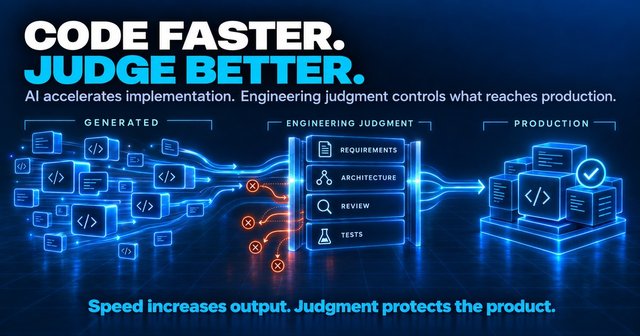
AI Coding Agents Move the Bottleneck From Code Generation to Engineering Judgment
AI agents can generate code quickly, but reliable delivery still depends on clear requirements, technical judgment, risk-based review and accountable production ownership.
Read insight
NGBS INSIGHT
You Need a Specialist. Do You Need a Permanent Hire?
A critical skills gap does not always require a permanent role. Assess the workload, urgency and ongoing ownership before choosing how to close it.
Read insight