
 Menu
 Close
NGBS INSIGHT
You Need a Specialist. Do You Need a Permanent Hire?
A critical skills gap does not always require a permanent role. Assess the workload, urgency and ongoing ownership before choosing how to close it.
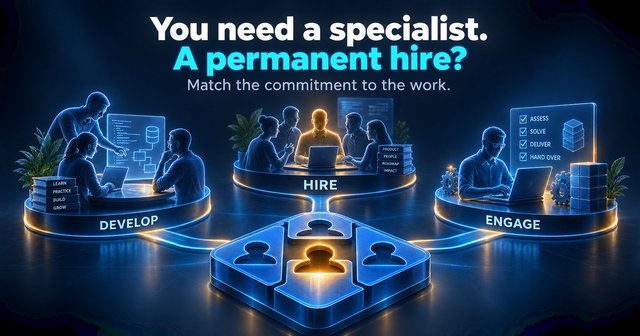
How to close a critical engineering skills gap without making the wrong long-term commitment.
A database migration is approaching. A performance problem is affecting an important customer. A new integration requires experience your team does not yet have.
The gap is real. Work is slowing, and someone needs to take responsibility.
Opening a permanent vacancy can feel like the obvious next step. But the decision deserves a second question: what will this person own after the immediate problem is solved?
A specialist requirement and a permanent role are different commitments. Choosing well means understanding how long the work will last, how often the expertise will be needed and who will maintain the result.
Define the work before choosing the arrangement
“Find a database expert” describes a skill. It does not define an outcome.
A more useful brief might be: assess the migration risks, validate the approach, support the cutover and prepare the existing team to operate the new environment.
That brief exposes the decisions you need to make. Which responsibilities are temporary? Which continue after delivery? Does the team need somebody to execute the work, review its approach or develop its own capability?
Start with five questions:
- What specific outcome is currently blocked?
- Which expertise is missing?
- How much of that expertise will the work require?
- What responsibility remains after the immediate work finishes?
- Who will own the result in normal operation?
Answer these with the engineers who will maintain the system. A staffing decision made without them can resolve a delivery problem while creating an ownership problem.
Separate an urgent project from a lasting capability need
Consider a hypothetical SaaS company moving a substantial workload to a new database platform.
It may need deep migration expertise during planning, testing and cutover. Afterward, its existing engineers may be able to operate the platform with appropriate preparation and support.
That could justify focused specialist involvement.
Now consider a company whose product continually evolves around complex data workloads. Database design, performance and operational decisions may be recurring, strategically important responsibilities.
A permanent hire could be the better choice—even if the migration first brought the gap to attention.
The technology is similar. The continuing responsibility is different.
Look beyond the current deadline. Review the expected roadmap and operational workload, and distinguish committed work from possibilities. Do not invent a full-time role around speculative projects merely to justify an urgent hire.
Develop internal capability when learning belongs on the roadmap
Building expertise internally makes sense when the capability will remain important and someone has the foundations, interest and time to develop it.
Give that person a bounded responsibility, access to experienced review and a realistic learning window. Decide which existing commitments will move to make room.
Training without practical ownership leaves the team dependent on outside help. Responsibility without guidance can expose the product to avoidable mistakes.
Internal development is a poor immediate answer when the deadline leaves no room for learning or when a high-risk change requires judgement the team cannot yet evaluate.
In that situation, experienced support can help the team deliver and learn together. Make the learning objective explicit: which decisions should the internal engineer be able to make independently afterward?
Hire permanently when there is a durable role to own
A permanent hire is worth considering when the specialist work recurs, requires sustained product context and forms a coherent ongoing role.
Write the role around responsibility. Explain what the person will own beyond the first project, who they will work with and how that responsibility may develop.
Also examine whether the work truly requires a narrow specialist throughout the year. A broader senior engineer with relevant depth may fit an evolving product better than a role defined around one immediate technology problem.
Allow for recruitment, onboarding and product learning. A permanent employee still needs access, context, relationships and clear decision boundaries before they can contribute independently.
If the work is urgent, handle the immediate delivery plan separately from the long-term hiring decision. An approaching deadline should not be the only reason you create a lasting role.
Use focused external expertise when the responsibility is bounded
External expertise can fit a defined piece of work, a specialist review or an uncertain requirement that needs investigation before a larger commitment.
Start with a clear boundary and acceptance criteria. For example, a performance investigation might produce a reproducible diagnosis, agreed improvements, validation results and an operational handover.
A useful first engagement may be an assessment rather than implementation. If nobody yet understands the problem, demanding a fixed delivery promise can encourage false certainty.
External support still consumes internal time. Someone must explain the system, make product decisions, review changes and accept responsibility for ongoing operation.
Evaluate the complete commitment: onboarding, access, collaboration, review, documentation and follow-up. A short engagement that leaves the team unable to maintain the result has not resolved the full problem.
Make knowledge transfer part of delivery
Avoid treating handover as a final presentation after all important decisions have been made.
Include the future owner in relevant design discussions, implementation reviews and operational preparation. Capture why an approach was chosen, its limitations and the conditions that would justify changing it.
Before the specialist steps away, ask the maintaining engineer to demonstrate an ordinary task, diagnose a representative failure and explain the escalation route.
The exact checks depend on the work. The principle is consistent: verify usable capability rather than counting documents.
Agree what happens if an issue appears after handover, including who responds and what support remains available. Do not leave those expectations implicit.
Choose the next commitment you can justify
You do not need perfect certainty about the next two years. You do need a defensible reason for the commitment you make now.
If the gap is unclear, investigate it. If the capability is durable and the team can learn safely, invest in development. If the workload supports ongoing ownership, consider a permanent role. If the work is bounded, assess focused expertise with a credible handover.
Set a review point when the evidence is likely to improve: after discovery, a first delivery milestone or a period of normal operation.
The right question is not simply whether you need a specialist. It is what responsibility you need, for how long, and what capability should remain afterward.
If you have a defined specialist gap, book a meeting with NGBS to discuss the expertise, delivery responsibility and continuity your team needs.
Related insights
NGBS INSIGHT
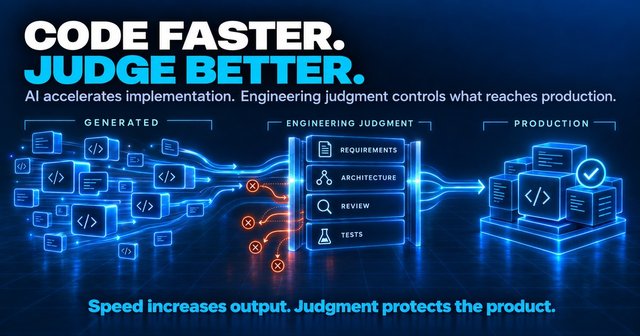
AI Coding Agents Move the Bottleneck From Code Generation to Engineering Judgment
AI agents can generate code quickly, but reliable delivery still depends on clear requirements, technical judgment, risk-based review and accountable production ownership.
Read insight
NGBS INSIGHT
Engineering continuity needs a handover plan
A stable engineering team matters, but continuity also depends on what happens when someone leaves or changes roles. Protect delivery with shared knowledge, clear ownership and a practical handover plan.
Read insight