
 Menu
 Close
NGBS INSIGHT
AI Coding Agents Move the Bottleneck From Code Generation to Engineering Judgment
AI agents can generate code quickly, but reliable delivery still depends on clear requirements, technical judgment, risk-based review and accountable production ownership.
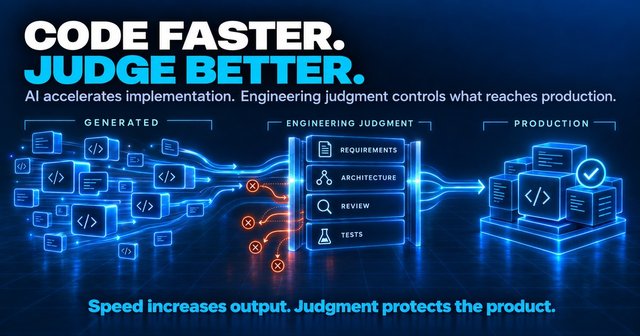
Faster code generation changes the constraint
AI coding agents can turn a well-bounded request into working code much faster than a team could type it by hand. That speed is useful. It can reduce the time spent on routine implementation, help an engineer explore an approach and make small changes less expensive to try. It does not, by itself, establish that the change solves the right problem or belongs in the product.
When implementation becomes cheaper, decisions upstream and checks downstream carry more weight. Someone still has to understand the business outcome, choose a technical boundary, assess the consequences of a change and decide when it is safe to release. The bottleneck moves from producing code to exercising engineering judgment around the code.
More generated code is not the same as more product progress
A larger volume of commits can look like progress while leaving the customer problem untouched. An agent may implement exactly what a task asks for, yet the task may describe a symptom rather than the cause. It may also add a new path through the system when the product would be better served by simplifying an existing one.
Product progress means a useful change reaches users without imposing disproportionate maintenance, security or operational cost. Teams should therefore start with the desired behaviour and the constraint that prevents it, not with the amount of code an agent can produce. A smaller change that resolves the constraint is often more valuable than an impressive generated patch.
The bottleneck moves to requirements and technical decisions
Requirements have to say what should happen, for whom and under which conditions. Ambiguity about permissions, failure states, data retention or ownership does not disappear when an agent writes code. It becomes an implementation choice made without the context to justify it. Engineering leaders need a way to surface these decisions before they are buried in a pull request.
Architecture matters for the same reason. A change must fit the existing system, its interfaces, deployment model and technical standards. The client should retain authority over product priorities and architectural boundaries, while the delivery team makes its implementation choices visible. Clear ownership lets agents accelerate execution without allowing generated code to set direction by default.
Agents need bounded tasks and explicit acceptance criteria
A useful agent task names the intended outcome, the files or interfaces in scope, relevant constraints and the evidence required for acceptance. It should say what must remain unchanged. A task such as “improve onboarding” leaves too many product and technical decisions implicit; a task to correct a specific validation path, with expected cases and exclusions, gives the agent a workable boundary.
Acceptance criteria should be written before implementation. Include normal behaviour, edge cases, accessibility where relevant and the failure mode that motivated the work. Ask the agent to report uncertainty rather than quietly deciding matters of policy or architecture. If the work reveals that the original task is incomplete, pause and revise the decision with the responsible human.
Review effort should follow risk, not line count
Human review is still necessary, but it need not mean reading every generated line with identical intensity. A low-risk, reversible copy or presentation change can receive a lighter review when focused checks and a clear diff support it. Changes to authentication, permissions, payment flows, personal data, public APIs or infrastructure warrant more deliberate scrutiny.
Reviewers should ask what can fail, how widely the failure can spread and whether recovery is straightforward. Architectural changes, data migrations and irreversible actions deserve explicit ownership and a rollback plan. An agent can help identify affected paths and assemble evidence, but a named engineer should judge whether the evidence is sufficient for the risk being accepted.
Tests cannot prove that the wrong requirement was implemented
Automated tests are essential for checking specified behaviour. They can show that a parser rejects a malformed input, that a permission check returns the expected result or that a page renders without a regression. They cannot independently prove that the specification reflects the user need, the contractual obligation or the intended business rule.
An agent may write code and tests from the same mistaken assumption. Both can pass while the product remains wrong. Review therefore needs two questions: does the implementation meet the stated acceptance criteria, and were those criteria correct? Product owners, domain experts and engineers may need to validate a change together, especially where terminology or consequences are easy to misunderstand.
A named human must remain accountable for production
Agents can propose changes, run checks and explain their reasoning. They should not become an unaccountable route into production. A named human must understand the release scope, review the material risks and decide whether the change is ready for the target environment. That person needs enough context to say no, narrow the release or request further evidence.
Accountability continues after deployment. The team should know who watches the outcome, who responds if behaviour differs from expectations and how to reverse or correct the change. Clear release ownership is particularly important when several agents or contributors have worked on related parts of a system. Automation can support that responsibility; it cannot absorb it.
Measure AI-assisted delivery by outcomes, not generated output
Counting prompts, generated lines or accepted suggestions tells little about whether a team is delivering better software. Useful measures stay connected to the product: time from a well-defined need to a safe release, escaped defects, recovery effort, maintainability and the quality of decisions recorded along the way. The right measures depend on the work and its risk.
Teams should also watch for hidden costs. Faster implementation can increase review queues, create duplicated patterns or move work into debugging and support. If those costs grow, the process needs adjustment even when code generation looks efficient. AI assistance is valuable when it improves the whole delivery system, not merely the speed of one step.
A practical operating model for agent-assisted engineering
The operating model should be simple enough to use on ordinary work and explicit enough to protect consequential changes. Start with a short brief that gives the agent a real problem and a bounded role. Then apply checks and human judgment in proportion to the impact of the result.
- Define the problem, affected users and business outcome before asking for implementation.
- Establish architecture, security and data boundaries, including what must not change.
- Give the agent a bounded task with relevant repository and interface context.
- State observable acceptance criteria and important edge cases in advance.
- Require automated checks that match the change, and report what they cannot establish.
- Apply risk-based human review, with deeper scrutiny for consequential or irreversible work.
- Validate the behaviour in the target environment without treating a successful build as proof of intent.
- Record technical decisions that future maintainers will need to understand.
- Keep a named human accountable for release approval and the recovery decision.
- Monitor the production result and feed what is learned into the next task.
This sequence is not a demand for the same ceremony on every change. A small reversible fix and a data migration should not travel through identical review paths. Both, however, need a clear owner, an appropriate definition of done and evidence that relates to the actual risk.
Speed requires stronger judgment
AI coding agents can make implementation faster and give engineering teams more room to explore. That is a capability worth using responsibly, not a reason to treat generated code as inherently unsafe or to assume it can replace technical leadership. The most effective use is to let agents handle bounded execution while people retain direction, standards and accountability.
As the cost of producing code falls, the value of sound requirements, architecture, review and production ownership rises. Teams that strengthen those practices can turn faster implementation into dependable product progress. Teams that neglect them may simply produce more change than they can understand or support.
Related insights

NGBS INSIGHT
You Need a Specialist. Do You Need a Permanent Hire?
A critical skills gap does not always require a permanent role. Assess the workload, urgency and ongoing ownership before choosing how to close it.
Read insight
NGBS INSIGHT
Engineering continuity needs a handover plan
A stable engineering team matters, but continuity also depends on what happens when someone leaves or changes roles. Protect delivery with shared knowledge, clear ownership and a practical handover plan.
Read insight