
 Menu
 Close
NGBS INSIGHT
Engineering continuity needs a handover plan
A stable engineering team matters, but continuity also depends on what happens when someone leaves or changes roles. Protect delivery with shared knowledge, clear ownership and a practical handover plan.

An engineer leaving should not mean the team loses the ability to explain, change or operate part of its product.
Yet a handover can look complete while leaving serious gaps. Repository access has been transferred. Documentation has been shared. A final walkthrough has taken place.
Then the remaining team encounters a production issue, an unusual customer configuration or an architectural decision that nobody can explain.
The missing piece is rarely just code. It is the context needed to work with that code confidently.
Continuity therefore needs more than a commitment to keeping people. It needs a practical plan for transferring responsibility when change happens.
Separate staffing continuity from knowledge continuity
Keeping experienced engineers involved helps preserve product understanding and working relationships. But no organisation can guarantee that every engineer will remain available indefinitely.
People change roles, take leave and move on. Client priorities also change, and an engagement may need to grow, reduce or pause.
Staffing continuity asks: who will do the work?
Knowledge continuity asks: can the people taking responsibility understand the system, make decisions and operate it safely?
A replacement can address the first question without resolving the second. Both deserve an explicit plan.
Transfer the reasoning behind the implementation
Useful handover material explains more than where files live.
It should help another engineer understand:
- Which constraints shaped the current design.
- Why a particular approach was chosen.
- Which alternatives were rejected and why.
- Where known risks and temporary workarounds remain.
- Which customer or operational requirements are easy to overlook.
Consider a background job that deliberately processes records more slowly than its infrastructure allows. Without context, a new engineer might “optimise” it and overload a downstream service.
A short decision record explaining that constraint can be more useful than a long document describing every function.
Record enough reasoning to support future decisions. The aim is to make the system understandable, not to document every line of code.
Make knowledge transfer observable
A walkthrough shows that someone explained the system. It does not establish that someone else can work with it.
Where practical, use a small, representative task to test the transfer.
The receiving engineer might make a bounded change, diagnose a familiar failure in a safe environment, or demonstrate how to release and roll back a service.
The outgoing engineer observes, answers questions and identifies missing context.
This reverses the usual handover dynamic. Instead of asking, “Have we covered everything?”, the team asks, “What can the next owner now do independently?”
Choose tasks proportionate to the system’s risk. A critical integration deserves more attention than a rarely used internal utility.
Keep the knowledge inside the client’s working environment
Handover material should remain accessible to the people who own the product.
Store decision records, operational guidance and outstanding work in the client’s agreed repositories and tools. Link them to the relevant services, issues and delivery processes.
Avoid leaving essential context in a supplier’s private workspace or an individual’s messages.
Access also needs deliberate management. Give the receiving engineer the permissions required for their responsibilities through the normal approval process. Transfer ownership of operational resources where necessary, and remove departing access at the appropriate point.
Continuity should not depend on sharing personal accounts or keeping former team members’ credentials active.
Agree responsibilities before the transition
A transition becomes harder when each party assumes the other is managing it.
For a dedicated engineering engagement, clarify who will:
- Identify the knowledge and responsibilities that need transferring.
- Arrange overlap where feasible.
- Prioritise handover work against delivery commitments.
- Confirm the receiving engineer’s readiness.
- Own any unresolved risks after the transition.
In a client-led team, the client’s technical leadership should retain control of technical acceptance and priorities. The engineering partner can support staffing coordination, availability and the agreed transition arrangements.
Where an NGBS technical lead coordinates day-to-day engineering delivery, the handover responsibilities should follow that agreed arrangement while preserving the client’s product direction and decision authority.
If notice or overlap is limited, prioritise the most critical systems and make the remaining gaps visible. Do not describe an incomplete transfer as complete simply because the departure date has arrived.
Build continuity before someone leaves
The strongest handover plan starts during ordinary delivery.
Review meaningful changes together. Keep operational instructions current. Record consequential decisions when they are made. Ensure critical areas have an informed secondary owner where practical.
This does not require everyone to know everything. It requires the team to recognise concentrated knowledge and reduce the dependencies that would be hardest to recover.
For engineering leaders working with a dedicated team, this is also a useful question to ask a potential partner: how will knowledge remain accessible to our organisation if the team changes?
A useful question for your next engineering review is:
If the primary engineer for this service were unavailable tomorrow, what could the remaining team confidently change, explain and operate?
The gaps in that answer are the starting point for your continuity plan.
Related insights
NGBS INSIGHT
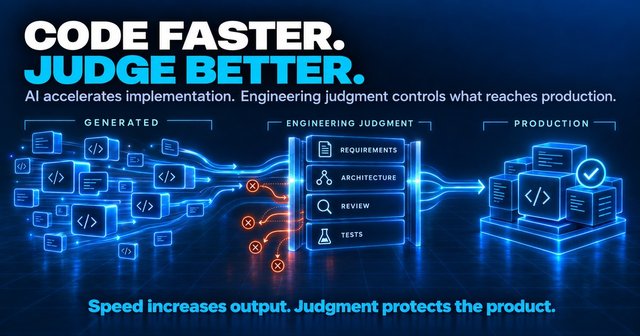
AI Coding Agents Move the Bottleneck From Code Generation to Engineering Judgment
AI agents can generate code quickly, but reliable delivery still depends on clear requirements, technical judgment, risk-based review and accountable production ownership.
Read insight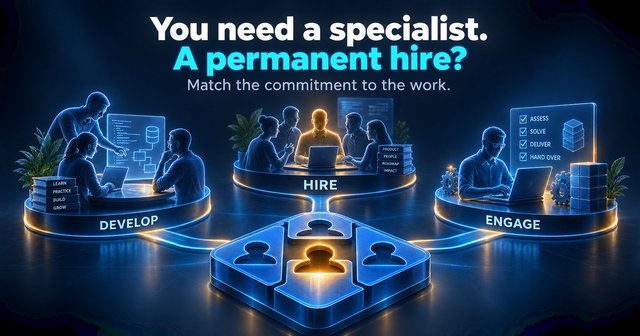
NGBS INSIGHT
You Need a Specialist. Do You Need a Permanent Hire?
A critical skills gap does not always require a permanent role. Assess the workload, urgency and ongoing ownership before choosing how to close it.
Read insight