
 Menu
 Close
NGBS INSIGHT
Build a dedicated engineering team around product constraints
The right dedicated team is shaped by the product’s current constraints, technical risks and leadership capacity—not by a generic list of engineering job titles.
A request for engineering capacity often begins with a number.
The organisation needs three developers, five engineers or an entire squad. Roles are listed, interviews are scheduled and delivery is expected to accelerate once the seats are filled.
Headcount matters, but it is not a team design.
The same number of engineers can produce very different results depending on the capabilities they bring, the work they are expected to own and the leadership available around them. A product constrained by frontend delivery needs a different team from one facing data migration risk, unreliable releases or a difficult mobile roadmap.
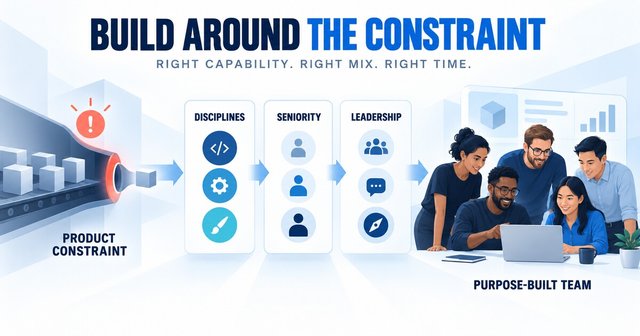
The strongest dedicated teams are built backwards from the product constraint. Leaders identify what is limiting progress, then choose the disciplines, seniority and operating responsibilities needed to address it.
Begin with the work, not the titles
Job titles are useful shorthand, but they hide important variation.
Two backend engineers may have very different experience with distributed systems, legacy modernisation, regulated data or high-volume integrations. A full-stack engineer may be ideal for a product area with tightly connected interface and API work, but a poor substitute for deep platform expertise where operational risk dominates.
Before defining roles, describe the work the team must make possible. Which product outcomes are blocked? Which parts of the system will the team change? What technical risks are present? Where does the existing team lack time, specialist knowledge or reliable ownership?
This description should be specific enough to guide selection. “Build features faster” is too broad. “Take ownership of the customer onboarding flow across the web application and supporting APIs while improving automated release confidence” begins to reveal the capabilities required.
Identify the dominant constraint
Most teams face several problems, but one or two usually shape the immediate design more than the rest.
The dominant constraint may be feature throughput in a well-understood product area. It may be the inability to change a legacy service safely, insufficient quality engineering, slow cloud operations or dependence on one overloaded senior engineer.
Naming the constraint prevents the organisation from solving the wrong problem with additional general capacity.
If releases are delayed by manual verification, adding more feature developers may increase the queue waiting for testing. If architecture decisions depend on one unavailable leader, adding junior engineers may create more questions without increasing decision capacity. If the work is highly defined but execution is limited, a group of experienced product engineers may be exactly right.
The constraint should influence the first composition of the team, not become a permanent label. As delivery improves, a different limitation may emerge.
Design across four dimensions
A practical team design considers more than individual technologies.
1. Product responsibilities
Define what the team will own.
Ownership may cover a customer journey, product module, platform capability, integration layer or delivery workstream. A coherent boundary helps engineers build context and make related decisions. A team assembled from unrelated tickets cannot develop the same depth of responsibility.
The boundary should also show where collaboration with the client’s existing engineers is required. Shared services, design systems, security controls and release processes often cross team lines. These interfaces need named owners and clear decision paths.
2. Engineering disciplines
Choose disciplines based on the work inside that boundary.
A team may need frontend, backend, mobile, quality, cloud or data capability. Not every discipline requires a full-time role from the first day. Some needs can be met through a specialist who joins at defined stages, while core product responsibilities remain with stable team members.
The important question is whether the team can complete work through the full delivery path. A group that can implement features but cannot test, release or operate them independently may create output while leaving the client with the same bottleneck.
3. Seniority and judgment
Seniority should reflect the uncertainty and consequence of the decisions involved.
Well-bounded work inside an established architecture may support a broader mix of experience levels. Ambiguous product areas, consequential migrations or complex system boundaries require stronger technical judgment and more independent problem-solving.
A team composed entirely of senior engineers is not automatically optimal. It may be unnecessarily expensive for predictable implementation work and can create unclear expectations about leadership. A team that is too junior, however, transfers analysis, review and decision work back to already constrained client leaders.
The right mix balances independent judgment with sustainable delivery economics.
4. Leadership capacity
Every team needs a clear route for priorities, technical direction, review and escalation.
Some clients already have strong product and engineering leadership and want the dedicated engineers to integrate under it. Others need an external technical lead to coordinate daily decisions and help maintain delivery discipline.
An external lead can support the team, but client accountability should remain explicit. The client still owns product direction, architecture boundaries and the risk it accepts. Team leadership should reduce coordination pressure without making control harder to locate.
Avoid the mirror-team assumption
Organisations sometimes copy the structure of an existing internal team: one frontend engineer, two backend engineers, a quality engineer and a lead.
That structure may be appropriate, but similarity is not evidence. The new team may own a different part of the product, face different technical risks or depend on shared capabilities already available internally.
A dedicated team should complement the organisation rather than duplicate it automatically. If the client already has strong platform engineering, the new team may consume that capability instead of recreating it. If quality is the current constraint, adding dedicated test automation expertise may matter more than preserving a familiar developer ratio.
The goal is one engineering organisation with a purposeful distribution of capability, not two symmetrical groups.
Test the design with real delivery scenarios
Before finalising the team, walk through representative work.
Who will clarify the customer outcome? Who can design the change, implement each layer, test it, review it and support its release? Which decisions stay within the team, and where will it depend on client specialists? What happens when an incident interrupts planned delivery?
These scenarios reveal missing capabilities and overloaded roles more effectively than an organisational chart. They also make interview criteria more precise because the client can assess candidates against the work they will actually perform.
Let the composition evolve
The first team design should be intentional, but it should not be fixed forever.
Review composition as the product area and constraint change. Early development may need architectural depth and close product collaboration. Later, the same area may benefit from stronger quality automation, operational ownership or additional implementation capacity.
Changes should preserve continuity wherever possible. Replacing engineers whenever the work shifts discards product context. A better approach is to develop existing team members, add targeted capability and adjust responsibilities deliberately.
At NGBS, clients interview and select the engineers who join their dedicated team. Those engineers work within the client’s roadmap, tools, technical standards and leadership model, while NGBS provides employment, continuity and operational support.
The principle is simple: do not begin with a standard team and search for work to fill it. Begin with the product constraint, then build the team capable of owning the work that resolves it.
Related insights
NGBS INSIGHT
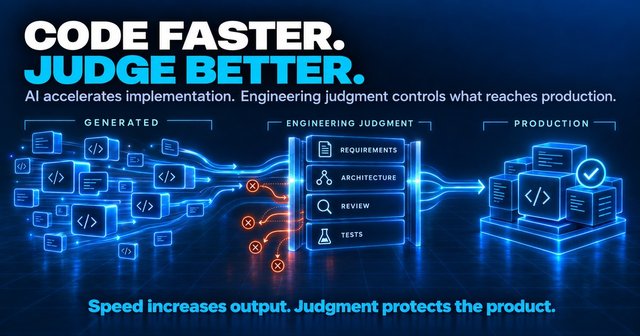
AI Coding Agents Move the Bottleneck From Code Generation to Engineering Judgment
AI agents can generate code quickly, but reliable delivery still depends on clear requirements, technical judgment, risk-based review and accountable production ownership.
Read insight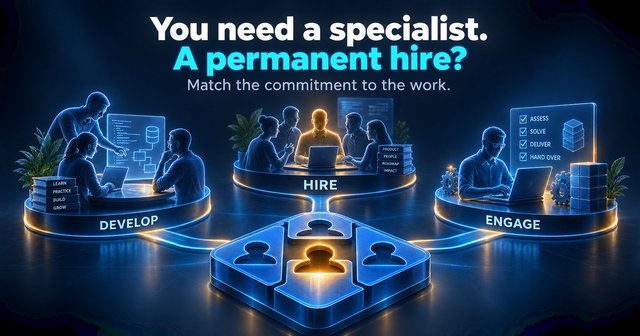
NGBS INSIGHT
You Need a Specialist. Do You Need a Permanent Hire?
A critical skills gap does not always require a permanent role. Assess the workload, urgency and ongoing ownership before choosing how to close it.
Read insight