
 Menu
 Close
NGBS INSIGHT
Design the first 30 days of a dedicated engineering team
A deliberate first 30 days helps dedicated engineers gain access, understand the product, deliver real work and begin taking ownership without lowering the client’s engineering standards.
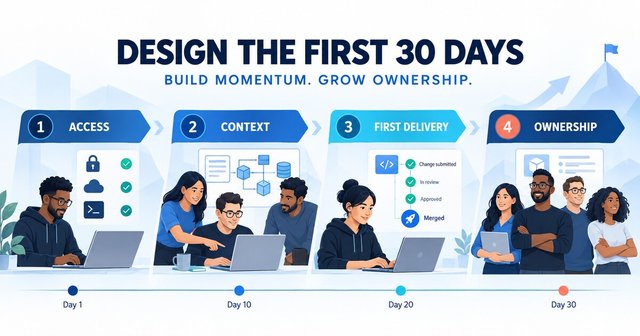
The first month of a dedicated engineering team is often treated as an informal settling-in period.
Accounts are created as requests arrive. Documentation is shared gradually. Engineers pick up small tickets while everyone waits for understanding to develop.
This approach feels flexible, but it creates avoidable delay. Engineers spend time discovering who can grant access, where decisions are recorded and which standards actually apply. Client leaders repeat the same explanations, while early work is either too trivial to build useful context or too risky for the knowledge available.
A stronger first 30 days is deliberately designed. It gives engineers a path from access to contribution, and from contribution to growing ownership. The objective is not instant independence. It is predictable progress without lowering the client’s engineering bar.
Start before the engineers arrive
The first day should not be the moment an organisation begins deciding how the team will work.
Before the start date, the client and engineering partner should agree on team structure, working hours, overlap expectations and escalation. Each engineer should know who owns product priorities, technical direction and daily coordination.
Access requirements should be identified in advance. This may include source control, work tracking, documentation, communication channels, development environments, observability and the non-production systems needed to investigate real behaviour. Security and approval processes still apply, but the requests can be prepared before they become blockers.
The client should also select an initial area of work. It needs to be meaningful enough to reveal how the product operates, yet bounded enough to review safely. A representative defect, modest product change or well-understood improvement is usually more useful than a collection of artificial onboarding exercises.
Days 1–5: establish context and working access
The first week should answer three questions: what are we building, how does this team deliver, and where can a new engineer act?
Begin with a concise product walkthrough. Explain the users, the problem the product solves, the current priorities and the outcomes the organisation is trying to improve. Engineers do not need the company’s entire history, but they need to understand why the selected work matters.
Technical orientation should connect architecture to daily work. Show the major system boundaries, critical data flows, deployment path and operational risks. Explain which architectural choices are deliberate, which areas are under change and which constraints cannot be compromised.
Access is only complete when an engineer can use it. Logging into a repository is not the same as being able to build, test and run the relevant part of the system. By the end of the first week, the team should identify missing permissions, unclear setup instructions and environmental differences while there is still time to correct them before delivery depends on them.
The engineering process must also be visible. New team members should see the definition of done, review expectations, branching approach, test requirements, release controls and decision path. Standards should be applied through normal work rather than presented as a disconnected handbook.
Days 6–15: deliver a real change through the full system
The first change should travel through the same path expected of future work.
That means understanding the problem, proposing an approach, implementing the change, testing it, receiving review and following the appropriate release or acceptance process. Removing every difficulty may make onboarding feel smooth, but it also hides the system the engineer must learn.
The work should be paired with access to an experienced internal engineer or technical owner. Their role is not to dictate every step. It is to explain hidden constraints, answer questions and make the reasoning behind feedback explicit.
Review quality matters during this stage. A list of corrections may produce acceptable code, but it does not transfer judgment. Feedback should explain why a pattern is preferred, what risk a test protects or how the change relates to a wider architectural direction.
Leaders should watch the delivery system as well as the engineer. If work waits for unclear acceptance criteria, unavailable reviewers or an unresolved product decision, the delay should not be misclassified as slow engineering. The first delivery is a useful test of the operating environment the client has created.
Days 16–23: broaden context and reduce dependency
Once the engineer has completed a representative change, the next work should extend understanding without introducing unnecessary risk.
This may mean taking responsibility for related tickets, investigating a production issue with appropriate supervision or contributing to refinement for an upcoming feature. The aim is to connect individual tasks into a product area rather than continuing with isolated work.
Engineers should begin to identify dependencies and propose options before implementation. They may still need confirmation, but the conversation should gradually move from “What should I do?” to “Here are the choices, trade-offs and my recommendation.”
This is also the right point to test decision rights. Confirm which routine choices the engineer can make, when consultation is expected and which changes need explicit approval. Clear boundaries allow autonomy to grow without transferring accountability accidentally.
Days 24–30: review the system and set the next horizon
The end of the first month should not be judged only by the number of completed tickets.
Review whether access is reliable, product context is improving and the engineer can navigate the delivery process without avoidable assistance. Examine the quality of questions, technical decisions, reviews and communication. Look for evidence that risks are being identified earlier and that ownership of a defined area is beginning to form.
Ask the engineer what remains unclear. New team members often see broken documentation, conflicting standards and decision bottlenecks that established teams have learned to work around. Their feedback can improve onboarding for everyone who follows.
Then define the next 30 to 60 days. Agree on the product area, expected responsibilities, technical development needs and measures of progress. The plan should describe growing contribution and ownership, not simply a larger volume of tickets.
Avoid two onboarding extremes
The first extreme is isolation. Engineers receive accounts and backlog items but little access to product thinking, technical history or the people who hold context. They appear busy but remain dependent on detailed instructions.
The second is immersion without structure. Engineers attend every meeting, read large collections of documents and absorb information without a clear route to applying it. Activity is high, but useful understanding develops slowly.
A deliberate first month balances context with real work. Each explanation supports an upcoming decision, and each piece of work exposes the next layer of context.
Design for contribution, then ownership
A dedicated engineering team should not remain in onboarding mode indefinitely. The first 30 days should establish the conditions for engineers to contribute safely and become less dependent over time.
At NGBS, clients interview and select dedicated engineers who work inside the client’s roadmap, tools, standards and delivery model. The client retains product and technical control, while NGBS provides employment, continuity and operational support behind the team.
The principle is practical: do not leave integration to chance. Prepare access before arrival, connect context to real delivery, make feedback useful and review whether ownership is growing. A well-designed first month does more than accelerate onboarding. It establishes how the team will work together after onboarding is over.
Related insights
NGBS INSIGHT
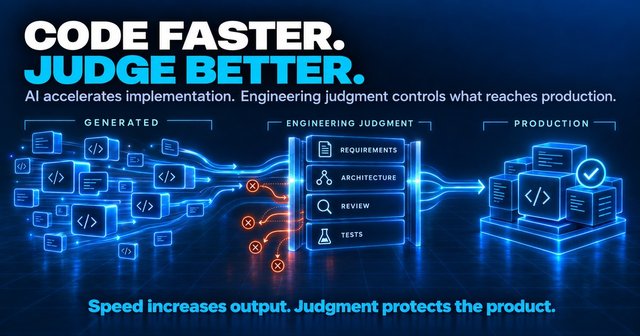
AI Coding Agents Move the Bottleneck From Code Generation to Engineering Judgment
AI agents can generate code quickly, but reliable delivery still depends on clear requirements, technical judgment, risk-based review and accountable production ownership.
Read insight
NGBS INSIGHT
You Need a Specialist. Do You Need a Permanent Hire?
A critical skills gap does not always require a permanent role. Assess the workload, urgency and ongoing ownership before choosing how to close it.
Read insight