
 Menu
 Close
NGBS INSIGHT
Measure a dedicated engineering team by product progress, not activity
Dedicated engineering teams create value through working software, sound decisions, reduced delivery risk and growing ownership—not through hours, ticket counts or constant visible activity.
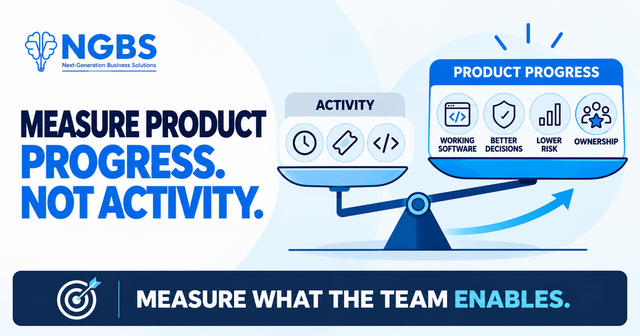
When leaders add external engineering capacity, they naturally want evidence that the investment is working. The easiest signals to collect are usually hours logged, tickets completed, pull requests opened and utilisation reported.
Those numbers describe activity. They do not necessarily describe progress.
A team can look busy while important decisions remain unresolved, releases become harder and the product accumulates more operational risk. Another team may complete fewer tickets while removing a major constraint, simplifying a fragile service or making the next quarter of delivery safer.
A dedicated engineering team should be evaluated through the same product and engineering outcomes expected from an internal team. The question is not whether the engineers were occupied. It is whether their work increased the organisation’s ability to deliver valuable software with confidence.
Activity is visible, but value is contextual
Activity metrics are attractive because they are easy to count and appear objective.
But a ticket is not a consistent unit of value. One may change a label; another may remove a failure mode affecting thousands of users. Lines of code can increase because a solution is unnecessarily complicated. More pull requests may reflect healthy delivery, or work fragmented into pieces that never produce a usable outcome.
Even velocity is meaningful only inside the team that estimates and uses it. Comparing it across teams, suppliers or time periods can encourage people to optimise the number rather than improve delivery.
These measures can help a team understand its own workflow. They become dangerous when leaders treat them as proof of engineering contribution.
Start with the product outcome
The most useful evaluation begins with a clear statement of what the team is expected to change.
That outcome might be releasing a new customer capability, reducing onboarding time, stabilising a critical service, improving deployment frequency or taking ownership of a neglected product area. It should connect engineering work to a real product, operational or business need.
The outcome must sit within the team’s reasonable control. Engineers cannot be held solely accountable for a commercial result shaped by pricing, marketing and sales. They can be accountable for delivering the capability, exposing assumptions, managing technical risk and showing it is ready to use.
When the outcome is clear, activity becomes supporting evidence rather than the objective.
Look for four forms of progress
Product progress is broader than feature completion. CTOs and engineering leaders should look for four connected forms of evidence.
1. Working product increments
The team should regularly turn priorities into software that can be reviewed, tested or used. Small, complete increments reveal more than long periods of reported effort because stakeholders can see what changed and respond with real feedback.
Progress does not require releasing to customers every week. Foundations, migration and risk-reduction work should still produce observable evidence: a service running in a target environment, a tested migration path, a performance benchmark or a demonstrated capability.
2. Better engineering decisions
Strong engineers improve the quality and speed of decisions around the product. They clarify trade-offs, identify hidden dependencies and record why an approach was chosen.
Look for fewer important questions waiting without an owner, clearer architectural reasoning and earlier escalation of constraints. A team adds value when it helps the organisation make difficult choices before those choices become urgent failures.
Decision quality is especially important in unfamiliar or mature systems, where producing code quickly can be less valuable than understanding what should not be changed.
3. Reduced delivery risk
Some of the most valuable engineering work prevents future disruption.
Automated tests may make releases safer. Better observability may shorten incident diagnosis. Removing a fragile dependency may reduce operational exposure. Documentation and shared understanding may prevent one person from becoming the only route to a critical system.
These changes are not secondary to delivery. They increase the team’s ability to keep delivering. Risk reduction should be made visible through concrete evidence rather than hidden inside a general claim about quality.
4. Growing ownership
A dedicated team should require less translation and repeated direction as it learns the product. Engineers should understand why priorities matter, raise concerns before being asked and take responsibility for following work through to completion.
Growing ownership does not mean acting without alignment. It means using context and judgment within agreed boundaries. The client retains control of product direction and technical standards, while engineers become more capable of moving work forward without unnecessary supervision.
This is one of the clearest signs that external capacity is becoming part of the real team rather than remaining a collection of assigned individuals.
Use a small, balanced evidence set
Measurement does not need a complicated dashboard.
For a product area or workstream, a useful review can usually answer five questions:
- What usable capability or engineering improvement changed during this period?
- Which important decisions were made, and which remain blocked?
- What delivery or operational risk was reduced—or introduced?
- What evidence shows that quality expectations were met?
- What can the team now own with less intervention than before?
Supporting measures can add context. Lead time, escaped defects, incident recovery, deployment frequency and work-in-progress may reveal constraints when they are relevant to the goal. They should be interpreted alongside the product rather than converted into a universal score.
The purpose of measurement is to improve decisions, not to manufacture certainty.
Review the system, not only the engineers
When progress is weak, individual performance is only one possible cause.
The team may be waiting for product decisions, working around unstable environments or receiving priorities that change before anything reaches completion. Access may be incomplete. Technical standards may conflict. Too much work may be started at once.
These are operating-system problems. Measuring activity can hide them because engineers remain visibly occupied while the system prevents valuable work from finishing.
A good review asks what is constraining the team and who can remove that constraint. This preserves accountability without assuming every delivery problem can be solved by asking engineers to work faster.
Make progress visible through normal delivery
Clients should not need a parallel reporting structure to understand whether a dedicated team is effective.
Evidence should come from the shared backlog, demonstrations, releases, decision records, quality checks and operational signals already used to manage the product. A concise review can connect those facts to the agreed outcome and identify the next risk or decision.
This approach keeps governance close to the work. It also discourages status reports that describe effort without revealing whether anything meaningful changed.
Measure the capability you intended to add
The reason to add a dedicated engineering team is not to purchase activity. It is to increase the organisation’s capacity to make sound technical decisions, deliver working software and take dependable ownership of part of the product.
At NGBS, dedicated engineers work inside the client’s operating model and are directed against the client’s priorities and standards. NGBS manages employment, support and continuity, while the client retains visibility and control over the engineering work.
That makes the right standard clear: judge the team by the product progress it enables, the risk it helps remove and the ownership it earns—not by how much motion it can report.
Related insights
NGBS INSIGHT
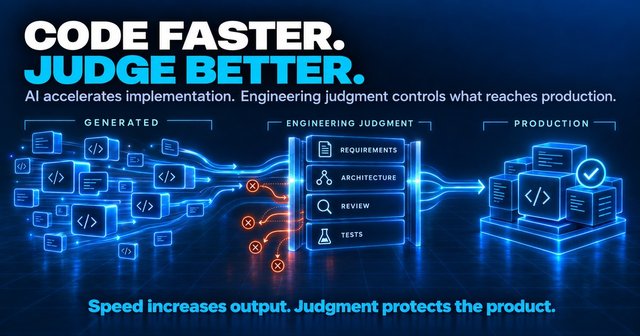
AI Coding Agents Move the Bottleneck From Code Generation to Engineering Judgment
AI agents can generate code quickly, but reliable delivery still depends on clear requirements, technical judgment, risk-based review and accountable production ownership.
Read insight
NGBS INSIGHT
You Need a Specialist. Do You Need a Permanent Hire?
A critical skills gap does not always require a permanent role. Assess the workload, urgency and ongoing ownership before choosing how to close it.
Read insight