
 Menu
 Close
NGBS INSIGHT
Your Senior Engineers Are Too Busy to Engineer
When every question, review and decision reaches the same engineer, important work stalls. Diagnose the dependency before adding more people.

How to identify what keeps pulling your strongest engineers away from the work only they can do.
A difficult architectural decision is still waiting. The reliability improvement planned last month has moved again. A critical integration needs sustained attention, but the engineer best placed to handle it cannot find an uninterrupted morning.
Meanwhile, that engineer has been busy all week: reviewing changes, answering questions, joining customer calls and helping colleagues get unstuck.
For a CTO, this creates an uncomfortable question: why is the team’s most experienced person working continuously while important engineering work barely moves?
Before opening another vacancy, examine what keeps arriving at that person’s desk—and why nobody else can move it forward.
Supporting the team is engineering work
Code reviews, mentoring and technical decisions are legitimate parts of a senior engineer’s role. An engineer who helps several colleagues make sound decisions may contribute more than someone who closes more tickets.
The problem begins when useful support becomes unavoidable dependence.
There is a difference between reviewing a consequential design choice and approving every routine implementation detail. There is also a difference between teaching someone how a service works and answering the same service question every week.
The aim is not to maximise a senior engineer’s coding hours. It is to reserve their judgement for work that needs it, while helping the team handle more work confidently.
Find out what the interruptions are telling you
Consider a hypothetical team preparing a customer-facing integration. One senior engineer understands the authentication flow, knows why an old data model behaves strangely and approves most backend changes.
A colleague asks about an undocumented exception. Another needs a review. Support asks whether a customer issue is a defect. Product needs a feasibility answer.
Each request is reasonable. Together, they make the integration dependent on whatever time remains.
For one working week, keep a lightweight record of requests that reach the senior engineer. Note what was needed, why it came to that person, whether someone else could have resolved it and whether it has happened before.
Use this as a diagnostic conversation, not individual productivity surveillance. The pattern matters more than a precise time total.
Look for four different causes:
- Concentrated knowledge: important context lives with one person.
- Unclear authority: people can do the work but do not know which decisions they may make.
- A capability gap: the team lacks experience in a particular area.
- Competing demand: support, delivery and discovery all draw on the same limited capacity.
These problems need different responses. Hiring against the wrong diagnosis can add another person to the queue.
Make routine decisions possible without escalation
If every change requires the same senior engineer’s approval, ask which approvals actually protect the product.
Define where engineers can decide independently, when another reviewer is sufficient and which changes require specialist scrutiny. Base those boundaries on risk and reversibility.
A routine change within an established service may need a competent peer review. A change to access control, data retention or a shared interface may require deeper review.
Keep relevant review and security controls intact. The objective is to make responsibility explicit, so the senior engineer does not become the default approver simply because everyone trusts them.
Write down a few concrete examples. “Use your judgement” is less useful than explaining which decisions belong to the team and what should trigger escalation.
Turn repeated questions into shared capability
Documentation helps when it answers a recurring question at the point where someone needs the answer.
Start with the questions that repeatedly interrupt delivery. Capture the reason behind an unusual design, a short troubleshooting path or a worked example of a common change.
Then pair another engineer through the next real task. Let them lead the following one, with review available.
The useful test is whether somebody else can complete the work, explain the decision and recognise when to ask for help. A document’s existence does not establish that knowledge has transferred.
Allow time for this work. Asking a senior engineer to transfer knowledge while keeping every delivery commitment unchanged simply creates another competing demand.
Protect focused work with a credible support route
Blocking calendar time will achieve little if every urgent question still goes to the same person.
Create an alternative route: a rotating first responder, a named backup for a service, or a shared queue with clear escalation criteria. Choose the arrangement that fits the team’s size and operational responsibilities.
For non-urgent questions, agreed review windows can reduce fragmentation. Genuine incidents still need prompt attention.
Managers and product leaders must support the arrangement. If every request bypasses it, the team learns that protected time is optional.
Start with one important piece of engineering work and a realistic focus window. Check whether the support route works before expanding the approach.
Add capacity when you can name the responsibility
Sometimes the diagnosis does point to insufficient capacity.
There may be more necessary engineering work than the team can reasonably own. A specialist gap may repeatedly pull a senior generalist away from their main responsibilities.
Before hiring or bringing in external engineers, define the responsibility they will take: a product area, a service, an integration or a bounded delivery workstream. Specify the decisions they can make, the standards they must meet and the support they will initially need.
Budget for onboarding and review. New people need context before they can reduce anyone else’s workload.
For an external team, assess its ability to work within your roadmap, technical standards and delivery rhythm. The relevant question is whether it can take meaningful responsibility and build shared capability.
Check whether dependence is actually decreasing
Choose one recurring source of demand and change how it is handled. After a few weeks, review:
- Can routine work proceed without waiting for the same person?
- Are repeated questions becoming less frequent?
- Is important engineering work receiving sustained attention?
- Are review quality and operational reliability holding up?
A quieter inbox is not enough if colleagues are now stuck silently. Look for greater independence alongside sound decisions and completed work.
Your senior engineers should help the team become stronger. When the team cannot move without them, examine the responsibilities, knowledge and capacity around them.
Before asking how many engineers you need, ask what your current team still needs the same person for.
If that review reveals a defined engineering capacity gap, talk with NGBS about adding engineers who work within your team’s direction, standards and delivery model.
Related insights
NGBS INSIGHT
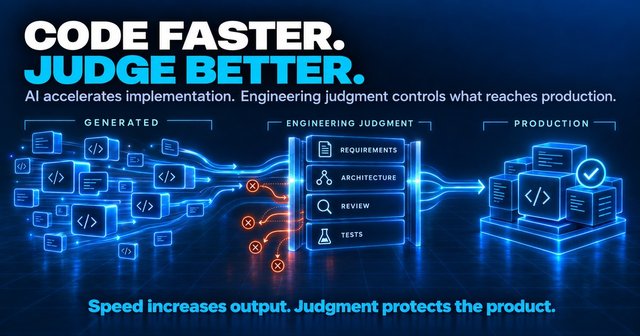
AI Coding Agents Move the Bottleneck From Code Generation to Engineering Judgment
AI agents can generate code quickly, but reliable delivery still depends on clear requirements, technical judgment, risk-based review and accountable production ownership.
Read insight
NGBS INSIGHT
You Need a Specialist. Do You Need a Permanent Hire?
A critical skills gap does not always require a permanent role. Assess the workload, urgency and ongoing ownership before choosing how to close it.
Read insight